#Podcast
From selling cars to selling a holiday
Isidoro left used cars for used caravans. In a strong month GranaCamp moves about 35 or 40 units, and 60 to 70 percent sell with no prior visit.

26 Oct, 2026 #Podcast
Ten years ago Israel Molina was earning a low wage. A motorcycle mechanic in Seville, he left a steady job to sit the local-police exams and ended up selling almost everything he owned. In episode #8 of the Veiko podcast, Rodrigo sits down with the founder of AutoBoss, in Mairena del Aljarafe, to see how a 3,000-euro Seat Córdoba became a stock of 120 to 130 high-end cars and supercars.
The conversation covers buying from official dealers in Germany, Belgium and France, a warranty that has paid a 26,000-euro gearbox, and nine days a year in a Lamborghini Temerario. Today half of sales come through social media.
For Israel, AutoBoss had to be something other than buying a car and leaving. He wanted premises where the buyer meets the people selling it — him included — and leaves having made a friend. A friend, Rodrigo adds, who likes motorsport: the showroom is a tribute to the Nürburgring, and the dealer organises drives.
The core product is mid and high end. What sells most is Audi, Mercedes, BMW and Volvo. Ferrari and Lamborghini sit alongside them. Someone comes in for an Audi and finds a sports car next to it. Stock moves so fast that Israel does not count it every morning. He talks about 120 to 130 cars.
Sale-or-return exists, and it is not the business. Anyone who brings a car gets two numbers: a purchase offer, or a consignment deal aimed at getting them more. On consignment, most of the margin stays with the customer. AutoBoss keeps a small commission and includes the warranty. They use it for house customers, as a favour. The filter is strict — one or two owners, accident-free — and it is applied before the car comes in. Israel puts it at 5%. He does not think they reach 8%.
Before a sale they check that the car is free of accident damage. Sometimes they do it themselves. Sometimes an outside firm does it. A small, non-structural knock can still be sold. The buyer has to know.
The example is specific. A clean car is worth 100,000 euros. The same car, with a wing repaired after a bump at the lights, is worth 90,000. Some buyers want original paint and pay what that costs, because few cars are like that. Others would rather save those 10,000 euros. He thinks both sales are fair. What he will not do is hide the damage.
It is his annual appointment. Nine days, agreed with his wife, Encarni. He compares it to the Rocío pilgrimage: she understands, and she has her own time away. They have children. For him it is not only an escape. He meets people, gets into places that need an appointment and that he cannot reach the rest of the year, and, he says, that is where a sports car actually makes sense.
This year they drove at Monza, the Nürburgring and Zandvoort, in the Netherlands, a circuit they closed for the group. Two circuits is the usual number. The one that changed the trip was the Nürburgring. He had never been on it. He had passed close many times, bringing cars back from Germany, and he did not stop: he would not add a day, even with the family. This time he arrived in the new car, with AutoBoss already built. “When I drove in, it was like being in heaven.”
He rarely takes the Temerario out. Five or six times. That is why those days feel different: eight or nine hours, five hundred or eight hundred kilometres, the Stelvio pass, the Targa Florio and the Mille Miglia, with about eighty sports cars around him. “If you like it, the long days don’t feel long.”
The story starts at Motocastro, in Seville. He was a motorcycle mechanic and became workshop manager under Manu de Castro. One day he wanted a change and started studying for the local police, mostly because he liked traffic management. He left a permanent job, went on unemployment benefit and bet everything. He sold the motorbike. He sold a Mercedes. Even then he was occasionally importing one car a month for a friend.
He was a poor student, and he says so plainly. On the first day he read a page and, at the bottom, could not remember what he had read. He does not like reading: if someone sends him a paragraph on WhatsApp, he calls. He left the job anyway.
When there was no money left, Encarni gave him a Córdoba of about 3,000 euros so he could get around. He had to sell it for that amount. He looked for a cheaper one, found it in Barcelona for 2,000, negotiated it down to fifteen hundred and something, brought it to Seville and sold it again. 1,200 or 1,500 euros in two or three days.
That changed the method. With 3,000 or 5,000 euros he could not invent the product: he had to see what Seville wanted at that price. The portals showed the Opel Astra, the Citroën Picasso, the Córdoba, the Mégane and the Ford C-Max, around 3,000 or 3,500 euros. The same car in Galicia, Bilbao or Barcelona was 2,000 or a little more. He called, negotiated and brought it down. One car, then two, three, four. He ended up with his street full of cheap cars. Then he jumped to France and Germany and moved up in price.
The exams did not work out. He says there was a serious problem, that they were rigged, and that he walked away. He also tells what came after: frustration, months of waking up in tears, and that his wife saw it. When that passed, he bet on cars. He had realised he was good at reading the market.
For four or five months he bought and sold as a private individual, without declaring it. His accountant stopped him: they could not keep transferring cars that way. He registered as self-employed. Three months later he rented a unit on the Pisa industrial estate for 600 euros. The mortgage was 400, Rubén, his eldest, was already there, and Encarni was working reduced hours. Between the rent and the self-employed fee he needed about 1,000 euros clear before the mortgage. He did not open it for appointments only. He opened with set hours, from day one, and stood inside.
He chose the name on the sofa. He did not want Autos Molina. He was watching Transformers with his son, then five or six, and the line “Autobots, transform” came on. He liked the sound. Autoboss: boss, car, short. He asked the boy, the boy said yes, and as they took the unit they designed the logo. In 2016 the first shop was on calle Horizonta. Five cars fitted.
In parallel he built something else. While studying he had back trouble, a friend suggested cycling and he got hooked. He designed kit, spoke to a manufacturer, made a logo and created Animal Race. He sold team clothing to the Andalusian Cycling Federation and to Seville clubs. He hired his sister-in-law because he could not keep up. It ran for two years and a bit, with serious turnover, and he sold it to a friend: he wanted the time for the cars. The brand is still going. In the photo of that first unit, Animal Race sat under AutoBoss. Upstairs, cycling kit. Downstairs, the cars.
There was no spare time. He says he was working 24 hours, 365 days, and that he went pale from not seeing the sun: he was either designing, buying or negotiating.

Auctions for professionals
At Veiko we auction cars exclusively to trade buyers. Weekly 100% online auctions, transparent prices and fast paperwork.
Register nowHe buys little in Spain. Over time, he says, he has found better quality in imports. He relies on Germany, Belgium and France. He does not buy from private sellers. He buys from official dealers, from the brand distributor, and in volume. His English is limited. He gets by with a translator, a list and a price. “I pay this, it’s worth that.”
He barely uses auctions. He goes in, like everyone else, but it wastes his time. Two or three distributors feed him what he wants and cut the price because he buys quantity. That is his comfort zone. In Spain he buys when people know him and call.
The latest batch worked that way. A fleet of 50 Mercedes GLA 200s from 2025, Spanish cars from Madrid, with about 22,000 to 25,000 kilometres and one year on them. White and black. Two years of official warranty left. Israel remembers the company as sales reps in prosthetic supplies. A Madrid contact sent the list, they agreed a price and he asked what it would be if he took all fifty. He took all fifty. They were the same car, and the price let him sell them cheap.
That rule goes back to the Córdoba. They sell on volume, and the car has to be the cheapest on the market for the same mileage, year and model. If it cannot be that price, he does not buy it. The old example: the cheapest C-Max in Spain at 3,000 euros, his at 2,900. If he needed 1,500 of margin, he had to find it around 1,600, negotiating down from 2,000. Volume is not there to widen his margin. It is there so the cost falls and the retail price is the best.
On a 3 Series about five years old, the same idea. He would rather have less equipment and a better price. On 70 to 75% of those sales they choose price, not the options pack. A plain 318 sells him five. A 320 with the M pack sells one. “Let’s see which makes more money.” Everyone likes the loaded car. He follows the margin.
That decision is made before the purchase, not when the ad has been sitting for weeks. It matches a dynamic pricing strategy.
They take part-exchanges. There is an appraiser. If the car fits — two or three owners, and the kind of car they sell — it comes in and they sell it. If it does not, the example is plain: six or seven years old, 180,000 or 200,000 kilometres. That is not their product. The appraiser posts it to a WhatsApp group of dealers, at a deliberately low price, so the buyer has margin. If it still does not fit, they tell the customer to take it to a chain. He mentions OcasionPlus.
Internal control is just as simple, and he does not sell it as a model. Growth arrived faster than the tools. Admin keeps a database for the accounts. Between him — he is the buyer — and the sales team there is a WhatsApp group. Every car has a reference. That number says whether it is sold. He does not claim it is the best system. He says it is the one they grew into, and that next year it may be another.
Rodrigo raises Veiko at that point: cars a dealer like AutoBoss does not keep, which today go to a handful of other traders, are seen by the trade on the auction. Israel already knew them. He calls it a good tool, with a better chance of selling than the usual group, and says he is going to try it. Veiko auctions run weekly, Wednesday to Friday, for professionals only. It is the same idea as not tying up stock in cars that are not the product.
The ordinary warranty, the one any dealer can offer, was already there. Premium is the name because it is total. Twelve months in which the customer pays nothing for a repair, whatever happens. Servicing and brake pads sit outside it. Repairs are covered in full. Israel says it so people can answer him: they have never refused a warranty claim. They have sometimes paid after the term, if the fault was already there. Argue about month thirteen, he says, and everyone turns up with an old breakdown.
The case he tells is a 2022 Porsche Cayenne, with Porsche history and no Porsche Approved, sold on the Premium warranty. The customer broke down in Madrid. Porsche offered an appointment more than a month away. They took it to a Porsche specialist and the diagnosis was 26,000 euros: the gearbox that links the hybrid system and the combustion engine. The car had sold for 70,000 or 80,000. They paid it. He does not care what share of the price that is. If he gave his word, he keeps it.
The sum that lets him say that: out of every ten cars, losing money on one is signed in advance. He thinks many dealers are wrong to demand a profit on every unit. On some you lose, and he treats that as normal. He has also refunded the money, kept the car, repaired it and put it back up for sale, or swapped it, when the fault was justified.
Going on social media did not change the rule. It confirmed it. He likes being greeted in the street. With his face on the videos, he says, it is harder to hide.
Until a couple of years ago, Coches.net was number one. The place you had to be. Israel says it has fallen hard, that fewer leads come in and that it is extremely expensive. The first channel now is social, taken together: Instagram, Facebook and the rest.
Out of every hundred cars, fifty sell through social. He could live on that alone and skip the portals. He would sell less, and spend much less. He still wants to be everywhere. Of the other fifty, about thirty go to Coches.net and twenty are split between Milanuncios, AutoScout24, Wallapop and the rest.
He does not close the six-platform ranking Rodrigo asks for. What he does separate is the job each one does. AutoScout24 does not bring him much, but it works for sports cars because it is seen across Europe. They sell outside Spain: Italy, France, Germany, Belgium, the Netherlands, Morocco, and also Ceuta, Melilla and the Canary Islands. A Ferrari 458 Italia went back to Italy. A Mercedes CLA 45 AMG that a customer had imported from Italy was bought from Italy again. Milanuncios, at this end of the market, barely works for him.
There are two kinds of content, and they do different work. The sales post — photo, spec and price — brings the buyer. The reel he appears in brings people who like cars, and sometimes someone who recommends him. A supercar video sells that car. You never know who walks in: the same doorway produces a 200,000-euro sale and a 10,000-euro sale, and he does not judge by clothes. It also lends weight. Someone who sees a Lamborghini and, next to it, a 30,000-euro BMW trusts the place a little more. He says that is not the only reason he does it.
The money, in his case, is not in the supercar. It is in the Audi, the Mercedes and the BMW at 15,000, 20,000 or 30,000 euros. He likes the sports cars and they bring people in. Some dealers live on them and make a lot; he is talking about his own yard. When the building work bites and he tells the team they need cash, they buy those cars, not a Huracán. They are in the middle of the building works and, he says, spending the cash down.
People who arrive through social close faster. They have already seen him. If the lead comes from a portal and hesitates, they finish with two things: Google reviews — more than a thousand positive ones, and negative ones too — and a video of him with that car. Some people, after watching, call and ask for the account number.
The car leaves both ways. Some buyers do not know Seville: AutoBoss collects them at the AVE station or the airport, recommends a hotel and where to eat, and they leave with the car. Others have no time: it goes on a truck.
A Huracán does not have a channel of its own. It comes from the drives, from social and from the portals at once. The AutoBoss drive is once a year, in October or November, and they have done four. Entry fee, breakfast at the dealer, the hills of Seville or Huelva, ham, cheese and a meal. About 30 to 35 cars. That is where the buyer already knows the person who will sell them the car. Everything else adds.
Gerardo Cabañas, in podcast episode #6, still ranked Coches.net as the one with the most traffic, and warned about its cost. Israel, with more than 160,000 followers across Instagram, TikTok and Facebook — Rodrigo’s figure, which he accepts — has reversed that order. If he had no followers tomorrow and could pay for only one portal, he would start again on Coches.net.
#Podcast
Isidoro left used cars for used caravans. In a strong month GranaCamp moves about 35 or 40 units, and 60 to 70 percent sell with no prior visit.
 #Podcast
Jon Magro of Gesticar Bilbao would rather make 3,000 euros in 30 days than 8,000 in 100. Each car left parked costs him about 15 euros a day.
 #Podcast
On the Veiko podcast, Francisco Pérez explains how Framacar grew from a Granada workshop into a BMW specialist selling about a hundred cars a month.
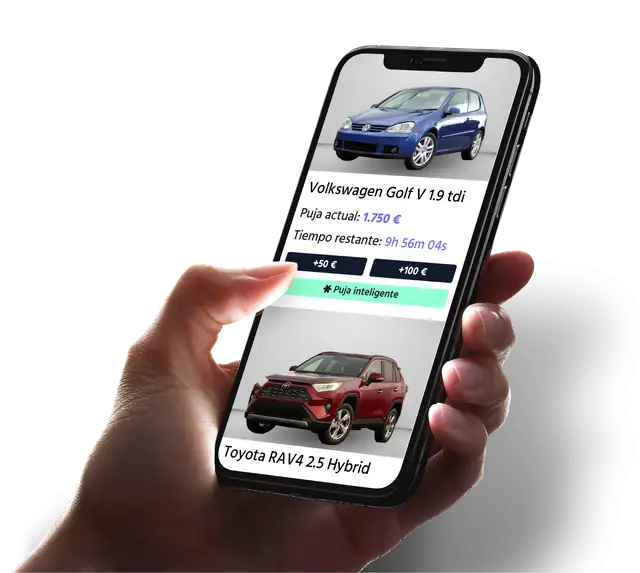
Download our app!
Access the best vehicle auctions from anywhere. Enjoy a fast, easy way to find the car you want and place bids from your phone. Start now!