#Engines
BMW engines
BMW petrol, diesel, hybrid and electric engines, from the first inline-sixes to modern BMW M powertrains.

12 Mar, 2026 #Engines
This is meant to be a journey of discovery and, at the same time, a practical, detailed guide through the world of engines, their manufacturers and the structure behind the car industry. It is written both for enthusiasts and people who know engines, and for used-car professionals, workshops and other players in the used-vehicle and new-vehicle market, but also for any reader who wants to understand better what they are buying or what they have already bought.
Because, in the end, behind every car there is much more than a brand or a model. There are industrial groups, manufacturers, engine families, mechanical evolutions, engines shared across different brands and, of course, blocks with well-known strengths and others with typical faults that are worth knowing. Understanding all that helps you buy with more judgement, value a vehicle for what is really under the bonnet and get a much more complete view of the market.
This first article will serve as the main index to place ourselves inside a subject that is as broad as it is fascinating. From here we will keep expanding, without rushing but without stopping, the information on the major manufacturing groups, the brands that belong to them, the engines they have developed and the models that have used them.
The idea is to build a useful, ordered and increasingly complete guide that you can come back to both to learn and to resolve a specific doubt at a given moment. And, if you work professionally in used-car retail, also to help you buy better, with more context and better judgement.
We hope you enjoy learning from all this information and that you find it genuinely useful and enriching, whether you come out of curiosity or you need a practical reference for your day to day.
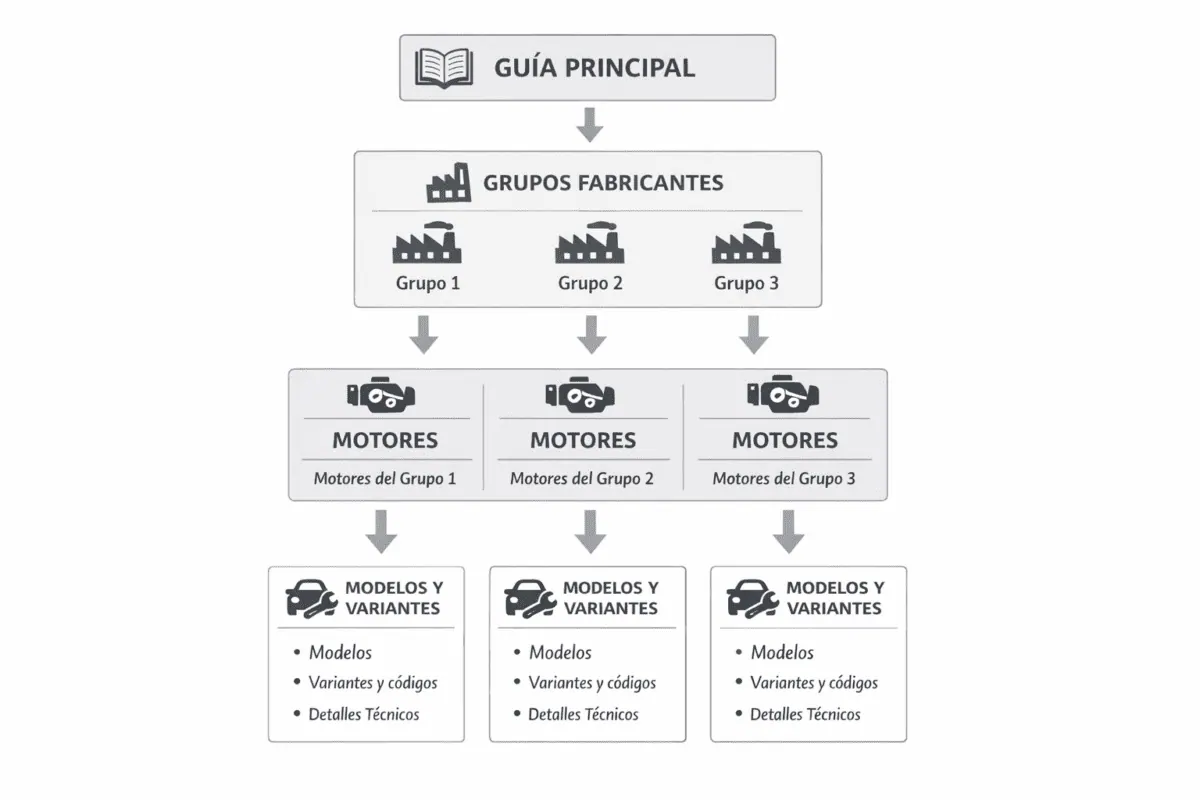
The hierarchy we will use to organise the information will start at the top, beginning with the major manufacturing groups, down to the last link in the chain: the engine, its different variations identified by their code, and the brands and models that have used it.
That way, you can travel the whole map from this main article. From here you will reach the major manufacturer groups and, inside each of them, the engines their brands have developed or used. Then, in each article dedicated to a specific engine, you will be able to see which models used it, what its variants are according to the engine code and which characteristics, strengths or weak points are worth knowing.
The idea is that this article works as a starting point to reach the specific contents of each manufacturing group and, from there, the articles on each specific engine, following a logical, ordered and increasingly detailed path.
When we talk about major European engine groups, we do not only mean manufacturers that produce cars under a single brand, but industrial conglomerates that bring several badges together and that, in many cases, share technological development, platforms, transmissions and mechanics.
This matters for several reasons. The first is that it helps you understand the market better: different brands can share much more than it seems. The second is that it helps you interpret a vehicle’s reliability and behaviour better, because knowing the origin of an engine is usually key to identifying its characteristics, its reputation and its typical issues. And the third is especially useful for professionals and informed buyers, because knowing who builds what, who shares mechanics with whom and in which models each engine has been fitted lets you buy with much more judgement.
In other words, understanding the groups is understanding the real map of the European car industry.
Below we collect the main European groups that will serve as the base of this guide. They are the big names from which we will later develop specific articles on each group and, after that, articles dedicated to each engine family.
See the specific Volkswagen Group article
Volkswagen Group is one of the great references of the European industry and one of the most important groups when talking about shared engines, common platforms and technical development applied to brands that are very different from each other. Its breadth makes it one of the best examples to understand how the same mechanical base can be adapted to vehicles with very different profiles.
Inside this group we find brands such as:
Stellantis is one of the broadest groups on the current European scene and a fundamental player for understanding the shared use of engines among volume, commercial and more premium-oriented brands. Its scale makes it especially interesting for analysing how the same mechanical family can appear in vehicles from very different segments.
Inside Stellantis, brands such as these stand out:
Renault Group occupies a key place on the European map of manufacturers and engines, both because of Renault’s historical weight and because of the projection of Dacia and Alpine. In the current context it is also especially important to mention HORSE, for its role in the development and management of combustion and hybrid propulsion solutions.
Inside this block we will work mainly with:
See the specific BMW engines article
BMW Group is one of the great European names in the development of premium-oriented engines, with a very marked mechanical identity and a particularly relevant track record in petrol, diesel and high-performance powertrains.
Inside this group we find brands such as:
See the specific Mercedes engines article
Mercedes-Benz Group is another pillar of the European car industry and an essential reference for understanding the evolution of premium, commercial and high-performance mechanics on the continent. Its industrial and technical history makes it a fundamental group in any guide to European manufacturers and engines.
Inside this group we will include:
See the specific JLR engines article
JLR occupies a very particular position on the European scene, with brands of strong identity and a track record marked by engines associated with luxury, off-road use and premium-oriented vehicles. It is an especially interesting group for studying how mechanics evolve inside brands with a very differentiated personality.
Here we will work with:
Besides the main large groups, this guide will also bring in specialised European manufacturers, especially premium, sports or niche brands that are interesting in their own right for their mechanical history, their exclusivity or the uniqueness of the engines they have developed or used.
This article is the starting point of a guide that will grow in a progressive, ordered way. From here you will be able to identify the major European manufacturer groups and use this base as a map to reach, later on, specific articles on each group and, from those, the contents dedicated to each engine.

Discover Veiko’s online auctions.
Looking for used vehicles for professionals, with clear information and no hidden fees?
Register now
#Engines
BMW petrol, diesel, hybrid and electric engines, from the first inline-sixes to modern BMW M powertrains.
 #Engines
The main Mercedes engine families in chronological order: petrol, diesel, hybrid and electric, production years and evolution.
 #Engines
Jaguar, Land Rover and JLR engines. The main petrol, diesel and hybrid families from the beginning, ordered by stage and chronology.
Download our app!
Access the best vehicle auctions from anywhere. Enjoy a fast, easy way to find the car you want and place bids from your phone. Start now!